
The industry has players that have exaggerated yield claims and we want real numbers. The closest to reality is what SunSolve delivers.
Nextpower prides itself on being very technically competent and technically driven and in trusting the scientific results. We just want the right answer. SunSolve is the best and the most technically competent.
Jenya Meydbray, VP and General Manager, Advanced Module Frames, Nextpower
Takeaways at a glance
The rapid adoption of bifacial technology introduced significant complexity into solar yield modelling, making it difficult to accurately quantify performance and validate vendor claims.
To address this, Nextpower partnered with SunSolve to obtain an accurate, physics-based understanding of bifacial gain for its NX Horizon platform, refining previous analysis and replacing standard industry assumptions with high-fidelity simulation.
Through a multi-year collaboration, Nextpower was able to:
- Optimise tracker designs for bifacial performance
- Generate accurate, bankable inputs for PVsyst
- Validate and demonstrate performance advantages with independent data
In a highly competitive market where fractions of a percent can impact project outcomes, this level of accuracy provided a decisive commercial advantage.
The collaborationFive years of engineering studies, not a one-off simulation
Nextpower’s engineering teams engaged with SunSolve between 2021 and 2026, a pivotal period for both the maturation of bifacial-plus-tracker deployments and Nextpower’s evolution into a leading utility-scale solar platform provider.
The collaboration began with SunSolve supporting detailed engineering studies to quantify the bifacial gains delivered by Nextpower’s NX Horizon single-axis trackers. These insights helped inform the optimisation of tracker designs and operational software.
Building on this foundation, Nextpower teams went on to leverage SunSolve’s high-accuracy modelling and advanced computational capabilities to demonstrate these performance advantages to project developers, investors, and EPCs.
The challengeIn utility-scale solar, minor details can have major impacts
Bifacial modules introduced a new level of complexity to yield modelling. Ground reflectivity became an important variable, one that can change throughout the year with snowfall, vegetation growth and soil type, while system components including torque tubes, rails, gearboxes, actuators, combiner boxes and DC cabling create rear-side shading that directly impacts irradiance on the back of the module.
Conventional yield modelling tools that rely on simplifications and assumptions struggle to capture that complexity, which has led the industry to depend on approximations and, in some cases, overly optimistic performance claims.
What the modelling resolvedThe tracker simulated in full geometric detail
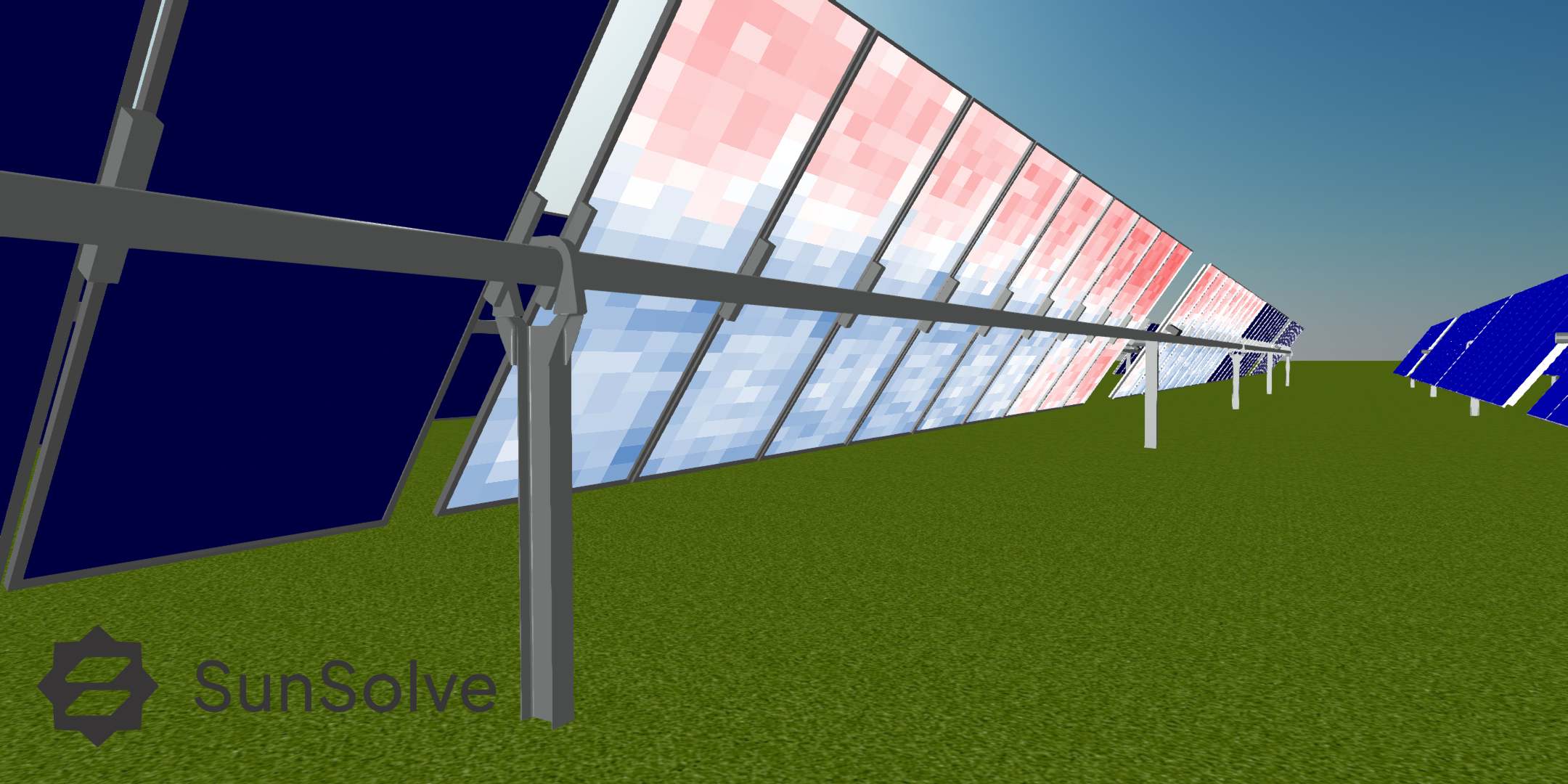
Nextpower deployed SunSolve’s advanced ray-tracing technology to simulate its tracker systems in full geometric detail. Rather than relying on approximations, SunSolve replicates the exact physical structure of the tracker, enabling precise modelling of how light interacts with every component.
Backside shading is caused by physical components, the torque tube, rails, wiring, gearboxes, all of these things matter, and their impact changes over time with sun position and ground conditions.
Jenya Meydbray, Nextpower
SunSolve enabled Nextpower to translate complex simulation results into energy-weighted parameters suitable for PVsyst, ensuring that final yield estimates most accurately reflected real system behaviour.
Why it matteredFractions of a percent decide vendor selection
In an industry where differences of less than one percent can determine vendor selection, the ability to accurately model rear-side irradiance and structural shading is critical.
By enabling independent, transparent validation of tracker performance, Nextpower can provide customers with data grounded in physical reality.
Even a quarter percent can make or break a deal.
SunSolve is a sophisticated physics-based engine that uses forward ray tracing modelling. For Nextpower that is important in understanding the detailed differences between different tracker architectures, and how those differences can influence bifacial gains, which is the rear-side power generated by the modules. The outcome is representative of a real-world Nextpower tracker.
Angel Velasco, Business Development Performance Engineering Manager, Nextpower